
Contents
Related Topics
How Much Does a Liver Transplant: Top 10 Affordable Countries (2026)
A liver transplant in the United States costs between $550,000 and $878,400 through 6 months of post-operative care. The same procedure, performed by JCI-accredited surgeons in Turkey, India, or Mexico, can cost as little as $22,000 to $70,000, savings of 75% to 94%. Across the ten countries below, we compare 2026 pricing, hospital accreditation, surgeon volume, donor laws, and waiting times so you can decide where the right balance of cost, quality, and access sits for your case. Turkey ranks first by combined criteria; the United States and United Kingdom appear last because they are reference points for how much a liver transplant costs without insurance, not affordable destinations.
Quick Cost Comparison: Liver Transplant by Country (2026)
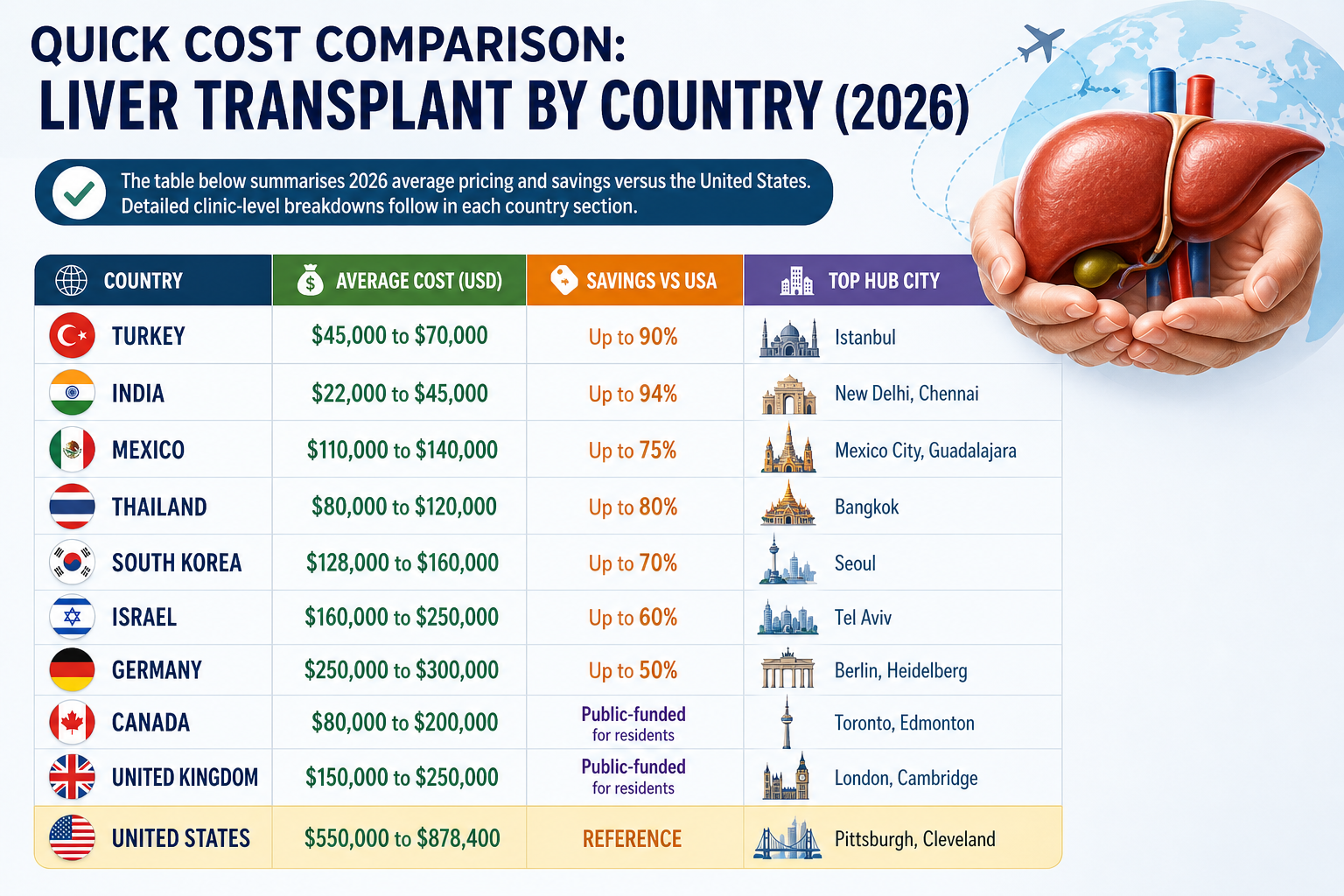
The table below summarises 2026 average pricing and savings versus the United States. Detailed clinic-level breakdowns follow in each country section.
|
Country |
Average Cost (USD) |
Savings vs USA |
Top Hub City |
|---|---|---|---|
|
Turkey |
$45,000 to $70,000 |
Up to 90% |
Istanbul |
|
India |
$22,000 to $45,000 |
Up to 94% |
New Delhi, Chennai |
|
Mexico |
$110,000 to $140,000 |
Up to 75% |
Mexico City, Guadalajara |
|
Thailand |
$80,000 to $120,000 |
Up to 80% |
Bangkok |
|
South Korea |
$128,000 to $160,000 |
Up to 70% |
Seoul |
|
Israel |
$160,000 to $250,000 |
Up to 60% |
Tel Aviv |
|
Germany |
$250,000 to $300,000 |
Up to 50% |
Berlin, Heidelberg |
|
Canada |
$80,000 to $200,000 |
Public-funded for residents |
Toronto, Edmonton |
|
United Kingdom |
$150,000 to $250,000 |
Public-funded for residents |
London, Cambridge |
|
United States |
$550,000 to $878,400 |
Reference |
Pittsburgh, Cleveland |
How We Ranked These Countries
This list does not rank countries by price alone. We weighted five criteria equally:
- Cost: average 2026 living donor liver transplant package in USD and EUR.
- Accreditation density: number of JCI-accredited or nationally-equivalent transplant centres.
- Surgical volume: annual liver transplants performed nationally and per leading hospital.
- Outcomes: published one-year and five-year graft survival rates.
- Access: visa and donor-law conditions for international patients, plus typical waiting time from listing to surgery.
Public-system countries (Canada, UK, Ireland) score well on outcomes but poorly on access for non-residents, which is why they sit further down the list despite excellent clinical results.
Why So Many Patients Travel Abroad for a Liver Transplant
Three forces push patients out of their home country. The first is price, a U.S. patient without insurance facing a $700,000 hospital bill saves $600,000+ by flying to Istanbul. The second is waiting time, the U.S. UNOS list runs from months to two years, and around 17,000 Americans are currently waiting; about one in three waits more than two years, and many die before an organ becomes available. The third is donor flexibility, countries like Turkey, India, and South Korea perform high volumes of living donor liver transplants from related donors, so families with a willing relative can be operated within weeks instead of years.
A separate study published in the American College of Gastroenterology journal (October 2024) found that U.S. liver transplant medication prices run nearly 5x higher than in G7 countries, and that gap continues for the rest of the recipient's life. Travelling abroad does not eliminate post-transplant drug costs, but it removes the single largest one-time hospital bill from the equation.
The 10 Best and Most Affordable Countries for a Liver Transplant
1. Liver Transplant in Turkey

Turkey is the global leader in living donor liver transplantation (LDLT) and the strongest combination of price, accreditation density, and surgical volume on this list. The country performs roughly 1,400 liver transplants every year across more than 40 specialised centres, and living donor procedures account for around 68% of cases, which is one of the highest LDLT rates in the world. The one-year survival rate sits near 87%, and several leading hospitals report adult-to-adult LDLT survival above 90%.
Average cost (2026): $45,000 to $70,000 USD (€42,000 to €65,000) for a complete living donor package, including donor evaluation, surgery for both donor and recipient, ICU, hospitalisation, and follow-up. The same procedure costs $550,000 to $878,400 in the United States, so Turkish packages save international patients roughly 85 to 90%.
Top clinics and surgeons in Istanbul, Antalya, and Ankara:
- Memorial Bahcelievler Hospital: led by Prof. Dr. Kamil Yalçın Polat, who has performed over 2,000 liver transplants. JCI-accredited.
- Acibadem Hospitals Group: over 500 liver transplants, success rate around 94%, JCI-accredited.
- Medipol Mega University Hospital: first Turkish hospital to earn JCI accreditation, 400+ liver transplants including paediatric cases under 10 kg.
- Medical Park Antalya Hospital Complex: Dr. Ibrahim Aliosmanoglu has completed 1,000+ liver transplants with a 90% success rate.
- Liv Hospital Istanbul: 350+ transplants with around 95% success.
- Istanbul Florence Nightingale Hospital: Prof. Abuzer Dirican authored the liver transplant chapter in Schwartz's Principles of Surgery.
Why Turkey leads: 60+ JCI-accredited hospitals, mandatory health-ministry oversight through the USHAS medical tourism authority, English/German/Arabic interpreter services, and no waiting list for living donor procedures (a related donor can be evaluated and operated within two to four weeks). Turkey also issues e-visas for almost all source markets, and Istanbul is a 3 to 4 hour flight from most of Europe and the Gulf.
Trade-offs to know: Foreign patients are restricted to living donor transplants only, deceased donor organs are reserved for Turkish citizens on the national list. This is standard across most medical-tourism destinations, but it means a related donor (parent, child, sibling, spouse) must be available and medically eligible.
For a procedure-by-procedure breakdown of clinics, surgeons, and packages, see our detailed guide on liver transplant cost in Turkey.
Read more: The Ultimate Guide to Liver Transplant Cost in Turkey (2026)
2. Liver Transplant in India

India is the single most affordable destination on this list and one of the highest-volume liver transplant regions in the world. The country performs more than 2,000 liver transplants annually, and major centres routinely report adult LDLT one-year survival of 85 to 90% and five-year survival of 70 to 75%, figures comparable with Western Europe and the United States.
Average cost (2026): $22,000 to $45,000 USD (€20,500 to €42,000). Living donor transplants typically run $22,000 to $35,000; deceased donor cases reach $40,000 to $45,000. Compared with the U.S., Indian patients save roughly 92 to 94%.
Top clinics and hubs (Delhi, Chennai, Hyderabad, Mumbai):
- Apollo Hospitals (Delhi/Chennai): pioneered Indian liver transplantation, 4,300+ procedures performed, packages from around $31,000.
- Max Centre for Liver Transplant and Biliary Sciences (Delhi): 2,600+ liver transplants, 200+ specialists, packages from around $28,000.
- Global Hospital (Chennai): home to Dr. Mohammed Rela, who has personally performed over 3,000 liver transplants.
- Fortis Healthcare (Gurugram/Bangalore): Dr. Vivek Vij has 17 years of experience and 2,500+ procedures.
- Medanta - The Medicity (Gurugram) and Kokilaben Dhirubhai Ambani Hospital (Mumbai), both leading high-volume centres.
Accreditation: Most premier Indian transplant centres carry both JCI (international) and NABH (national) accreditation, and India hosts more than 600 NABH-accredited hospitals overall.
Trade-offs to know: Indian transplant law mandates that living donors must be first-degree relatives (parent, child, sibling, or legally married spouse with proof of marriage), and every case must clear an authorisation committee. Deceased donor transplants are not available to foreign patients. Air pollution in Delhi and travel distance from Europe/North America are practical considerations during the typical 4 to 6 week recovery stay.
3. Liver Transplant in Mexico

Mexico is the natural choice for North American patients who want significant savings without crossing oceans. The transplant programme is concentrated in Mexico City, Guadalajara, Monterrey, and the U.S.-border cities of Tijuana and Mexicali, where Hospital de la Familia alone has performed more than 3,000 living-related liver transplants.
Average cost (2026): $110,000 to $140,000 USD (€103,000 to €131,000). That is roughly 60 to 75% less than the U.S. average, and patients can drive across the border instead of flying long-haul, which keeps logistics simple for U.S. and Canadian families.
Top clinics and hubs:
- Hospital de la Familia (Mexicali): 3,000+ living-related liver transplants, located minutes from the Calexico, California border crossing.
- Hospital Ángeles (Mexico City and Tijuana): multi-organ transplant programme with U.S.-trained surgeons.
- Hospital San José Tec de Monterrey: academic transplant centre affiliated with Tecnológico de Monterrey.
- Hospital Médica Sur (Mexico City): JCI-accredited tertiary hospital.
Accreditation: Tier-1 Mexican hospitals carry both JCI and Consejo de Salubridad General (CSG) accreditation, the federal Mexican equivalent.
Trade-offs to know: Mexican transplant volume is lower than India or Turkey, donor matching can take longer (4 to 12 weeks), and quality varies sharply by region. Border-city packages are convenient but always verify CSG accreditation and surgeon volume. Mexico City clinics generally have stronger academic programmes than border facilities.
4. Liver Transplant in Thailand

Thailand has the deepest medical-tourism infrastructure in Southeast Asia and one of the highest concentrations of JCI-accredited hospitals on the planet, over 60 JCI-certified facilities nationwide. Bangkok is the main transplant hub, and Thai centres handle large volumes of patients from the GCC, Australia, and East Asia.
Average cost (2026): $80,000 to $120,000 USD (€75,000 to €112,000). Pricing sits between Mexico and Turkey/India, but Thai packages are unusually all-inclusive: long hospital stays, hotel-style recovery suites, transfers, and interpreters are typically bundled.
Top hospitals:
- Bumrungrad International Hospital (Bangkok): treats more than 1.1 million international patients annually, JCI-accredited.
- Bangkok Hospital (Bangkok): flagship of the Bangkok Dusit Medical Services group, multi-organ transplant programme.
- Samitivej Hospital and King Chulalongkorn Memorial Hospital, academic and private leaders.
Trade-offs to know: Thailand has shorter overall liver transplant track record than India or Turkey, annual volume is lower and most centres focus on living donor cases. Long-haul flights from Europe and North America (12 to 18 hours) are a meaningful consideration for patients with end-stage liver disease.
5. Liver Transplant in South Korea

South Korea posts the highest documented LDLT outcomes anywhere in the world: 92 to 94% one-year survival at top centres and roughly 13.6 living-donor liver transplants per million population, the highest rate globally. Asan Medical Center in Seoul alone performs more living donor liver transplants than any single hospital on Earth.
Average cost (2026): $128,000 to $160,000 USD (€120,000 to €150,000). Roughly 70 to 80% cheaper than the U.S., with shorter wait times and outcomes that match or beat U.S. academic centres.
Top hospitals:
- Asan Medical Center (Seoul): the largest hospital in South Korea; performs 45% of all heart transplants in the country and is the global LDLT volume leader.
- Samsung Medical Center (Seoul): ranks among Newsweek's top hospitals globally; integrated transplant and oncology unit.
- Severance Hospital (Yonsei University): Korea's first Western-style hospital, JCI-accredited.
- Gachon University Gil Medical Center: packages around $140,000 covering surgery, diagnostics, and 14 days hospitalisation.
Trade-offs to know: Korean centres are excellent but expensive relative to Turkey or India. Foreign patients need a related living donor; deceased-donor allocation prioritises Korean nationals. Language can be a barrier outside JCI-flagged international wings.
6. Liver Transplant in Israel

Israel runs one of the most technologically advanced organ transplant programmes in the Middle East, with leading centres at Sheba Medical Center, Hadassah, and Rabin Medical Center. The country is particularly strong in paediatric liver transplantation and complex re-transplant cases.
Average cost (2026): $160,000 to $250,000 USD (€150,000 to €234,000). More expensive than Turkey or India, but typically 40 to 60% cheaper than the U.S. and easier to access for European patients.
Top hospitals:
- Sheba Medical Center (Tel HaShomer): ranked by Newsweek among the world's top 10 hospitals.
- Hadassah Medical Center (Jerusalem): academic centre with strong paediatric liver programme.
- Rabin Medical Center (Petah Tikva): Israel's highest-volume transplant hospital.
- Assuta Medical Centers: leading private group, performs more than 92,500 procedures annually across all specialties.
Trade-offs to know: Israel allocates deceased-donor organs primarily to Israeli citizens, and waiting lists for foreigners can be long unless a living donor is available. Costs are not low, and travel/accommodation in Tel Aviv adds materially to total spend.
7. Liver Transplant in Germany

Germany is the heavyweight of European transplant medicine. University hospitals like Charité Berlin, Hannover Medical School, Heidelberg, and Essen run high-volume programmes integrated with active clinical research, and Charité alone has logged more than 2,500 liver transplants over the past two decades.
Average cost (2026): $250,000 to $300,000 USD (€235,000 to €280,000). Success rates of 85 to 90% at major centres, with techniques like normothermic machine perfusion that keep donor organs metabolically active before implantation. This technology is not yet widely available in lower-cost destinations.
Top hospitals:
- Charité, Universitätsmedizin Berlin: Dr. Johann Pratschke leads complex laparoscopic liver work; 2,500+ transplants performed.
- Hannover Medical School (MHH): one of the founding Eurotransplant centres.
- Heidelberg University Hospital and Essen University Hospital, integrated transplant-research programmes.
Trade-offs to know: Germany operates inside the Eurotransplant allocation network, which means foreign self-paying patients face the longest waits on this list (commonly 6 to 24 months) unless they bring a living donor. Krankenkasse public insurance only covers German residents; international patients pay out-of-pocket.
8. Liver Transplant in Canada
Canada delivers high-quality, publicly-funded liver transplantation through provincial systems centred on the University Health Network (Toronto), University of Alberta Hospital (Edmonton), McGill University Health Centre (Montréal), and Vancouver General Hospital. Outcomes are comparable to U.S. academic centres.
Average cost (2026): For Canadian residents, the procedure is fully covered by provincial healthcare. A 2017 to 2018 University of Alberta cost analysis put a single liver transplant admission at approximately CAD $102,597 (about $76,000 USD) excluding physician fees. For self-paying international patients, total billed costs typically run $80,000 to $200,000 USD depending on hospital and complications.
Top hospitals:
- Toronto General Hospital (UHN): Canada's highest-volume liver transplant centre.
- University of Alberta Hospital (Edmonton): pioneer of normothermic machine perfusion in Canada.
- McGill University Health Centre (Montréal) and Vancouver General Hospital, major regional centres.
Trade-offs to know: Canada's public system prioritises residents, and foreign self-pay patients face waiting lists that can stretch from months to several years. Many Canadians on the deceased-donor list reportedly die before receiving an organ, which is exactly why Canadians make up a meaningful share of patients flying to Turkey, India, and Mexico for living donor procedures.
9. Liver Transplant in the United Kingdom (and Ireland)
Liver transplantation in the UK is delivered through seven NHS Blood and Transplant-designated centres, with King's College Hospital London, Royal Free Hospital, Addenbrooke's (Cambridge), and Queen Elizabeth Hospital Birmingham handling most of the national caseload. King's College Hospital is one of the largest liver transplant programmes in Europe.
Average cost (2026): Free at the point of care for NHS-eligible patients. For private and international patients, UK liver transplant pricing averages $150,000 USD (~£118,000 / €140,000), with premium centres reaching $250,000 USD. Ireland runs a single national programme at St. Vincent's University Hospital, Dublin, also publicly funded for HSE patients.
Top centres:
- King's College Hospital London: global reference centre for hepatology and acute liver failure.
- Royal Free Hospital, London: one of the founding UK transplant centres.
- Addenbrooke's Hospital, Cambridge: paediatric and adult liver programmes.
- Queen Elizabeth Hospital Birmingham: Europe's largest single-site liver unit by volume.
- St. Vincent's University Hospital, Dublin: Ireland's national liver transplant centre.
Trade-offs to know: NHS waiting times for non-urgent listings can run several months, and patients ineligible for NHS coverage pay full private rates. Ireland's national programme has historically had limited capacity, which is why Irish patients appear on UK and continental European waiting lists. Both UK and Irish patients increasingly look at Turkey when a related donor is available, since LDLT in Istanbul takes weeks rather than months.
10. Liver Transplant in the United States
The United States runs the world's most expensive liver transplant programme, and one of the most clinically advanced. UNOS oversees more than 120 transplant centres, and approximately 6,000 liver transplants are performed every year. Mayo Clinic, Cleveland Clinic, UPMC, and Houston Methodist consistently rank among the global top tier.
Average cost (2026): $550,000 to $878,400 USD (€515,000 to €820,000) per Milliman actuarial data, covering 30 days pre-transplant through 6 months post-transplant. Liver transplant cost without insurance in the U.S. is essentially unmanageable for the average household; liver transplant cost with insurance still leaves significant out-of-pocket exposure through deductibles, copays, and immunosuppressant drug costs that can exceed $30,000 per year indefinitely.
Top hospitals:
- Mayo Clinic (Rochester, Phoenix, Jacksonville): multi-campus high-volume programme.
- Cleveland Clinic, Ohio: academic flagship with strong outcomes data.
- UPMC, Pittsburgh: home of the modern liver transplant pioneered by Dr. Thomas Starzl.
- Houston Methodist and Johns Hopkins (Baltimore), top academic transplant programmes.
Why the U.S. is so expensive: A 2024 ACG study found U.S. originator immunosuppressive drug prices average 4.84 times the price in G7 countries and Australia, and U.S. generic versions run 6.32 times the average across Canada, France, Japan, Italy, and Germany. Hospital billing also includes organ procurement, transport, and overhead costs that other healthcare systems fund through public budgets.
Trade-offs to know: Outcomes are excellent, but the U.S. UNOS waiting list runs from months to two years, and roughly 17,000 Americans are currently waiting for a liver. About one third wait more than two years, and many die before receiving an organ. This is the structural reason why hundreds of U.S. patients now travel abroad each year for living donor liver transplants.
Detailed Comparison: Accreditation, Wait Times, Donor Laws
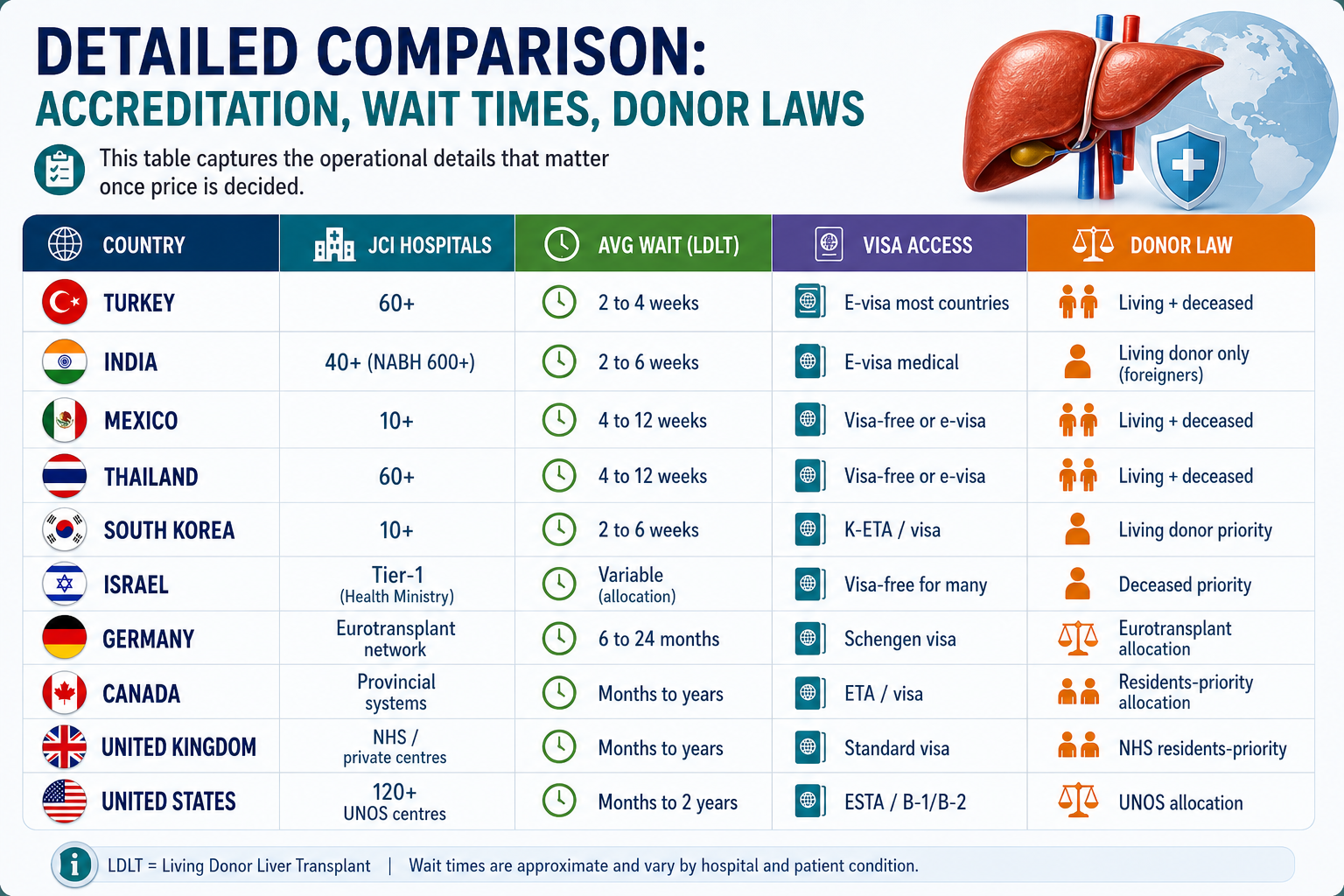
This table captures the operational details that matter once price is decided.
|
Country |
JCI Hospitals |
Avg Wait (LDLT) |
Visa Access |
Donor Law |
|---|---|---|---|---|
|
Turkey |
60+ |
2 to 4 weeks |
E-visa most countries |
Living + deceased |
|
India |
40+ (NABH 600+) |
2 to 6 weeks |
E-visa medical |
Living donor only (foreigners) |
|
Mexico |
10+ |
4 to 12 weeks |
Visa-free or e-visa |
Living + deceased |
|
Thailand |
60+ |
4 to 12 weeks |
Visa-free or e-visa |
Living + deceased |
|
South Korea |
10+ |
2 to 6 weeks |
K-ETA / visa |
Living donor priority |
|
Israel |
Tier-1 (Health Ministry) |
Variable (allocation) |
Visa-free for many |
Deceased priority |
|
Germany |
Eurotransplant network |
6 to 24 months |
Schengen visa |
Eurotransplant allocation |
|
Canada |
Provincial systems |
Months to years |
ETA / visa |
Residents-priority allocation |
|
United Kingdom |
NHS / private centres |
Months to years |
Standard visa |
NHS residents-priority |
|
United States |
120+ UNOS centres |
Months to 2 years |
ESTA / B-1/B-2 |
UNOS allocation |
Decision Guide: Which Country Is Right for You?
For the lowest absolute price: India ($22,000 to $45,000), paired with high-volume surgeons and 2,000+ annual cases.
For the best balance of cost and quality: Turkey ($45,000 to $70,000), 60+ JCI-accredited hospitals, no waiting list for related donors, and the world's highest LDLT share.
For North American patients who want to drive across a border: Mexico ($110,000 to $140,000), Tijuana and Mexicali clinics are minutes from California.
For the highest documented outcomes regardless of price: South Korea, 92 to 94% one-year survival, the global LDLT volume leader at Asan Medical Center.
For European patients who want to stay inside the EU: Germany, Eurotransplant access if eligible, normothermic machine perfusion, but expect 6 to 24 month waits.
For paediatric or complex re-transplant cases: Israel, strong Sheba and Hadassah programmes.
For patients with existing public coverage: UK and Canada, free at point of care if eligible, but waiting times are the longest barrier.
How to Choose the Right Country and Hospital
Six things to verify before signing any package agreement:
- Confirm JCI or local equivalent accreditation directly on the JCI website, not just on the hospital's marketing page.
- Ask the hospital for the named lead surgeon's annual liver transplant volume, sub-25/year volumes correlate with worse outcomes.
- Get the package scope in writing: donor evaluation, donor surgery, recipient surgery, ICU, hospital days, immunosuppressants, complications coverage.
- Verify donor law in the destination country, most require first-degree relatives and an authorisation committee.
- Ask about post-transplant follow-up: where will labs, immunosuppressant dose adjustments, and rejection monitoring happen once you fly home?
- Request real patient references, not testimonials on the website, but contactable past patients from your country.
Hidden Costs to Plan For Before You Travel
The headline package price never captures the full cost. Realistic add-ons include: donor evaluation tests ($2,000 to $5,000 if not bundled), extended ICU stays if complications arise (up to $1,500/day in private rooms in Turkey, $5,000+ in Germany), immunosuppressant medication for life ($3,000 to $30,000 per year depending on country), post-transplant flights and lodging for follow-up at 3, 6, and 12 months, and interpreter or patient coordinator fees if not included. Add a 15 to 25% contingency to any quoted package to plan honestly.
Risks of Choosing the Cheapest Option
Liver transplantation is the single most complex elective surgery a person can have. Picking purely on price has cost patients their lives. Warning signs: hospitals that refuse to publish surgeon-level outcomes, packages that exclude complications, no clear plan for post-operative immunosuppression management, no on-site hepatology team, and any clinic that pressures you to commit before sharing complete medical documentation. Below $20,000 USD is a red flag for adult liver transplant, the donor evaluation alone costs more than that at any reputable centre.
Final Word
Turkey, India, and Mexico dominate affordable liver transplantation in 2026 by combining JCI accreditation, high surgical volume, and per-procedure savings of 75% to 94% versus the United States. South Korea, Israel, and Germany offer the most advanced techniques but cost two to four times more. The U.S., UK, Ireland, and Canada remain reference points more than destinations: clinical excellence is high, but waiting times and out-of-pocket costs push thousands of patients abroad each year. The right answer depends on whether your priority is price, outcomes, or timing, and whether you have a related living donor available.
If you want a personalised cost breakdown and clinic shortlist for your specific case, including hospitals in Istanbul that match your blood group, MELD score, and budget, A-Medical can coordinate the full medical pathway, donor evaluation, visa, accommodation, and post-operative follow-up from a single point of contact.
Frequently Asked Questions
How much does a liver transplant cost without insurance?
In the U.S., a liver transplant without insurance costs $550,000 to $878,400 for the procedure and 6 months of follow-up, plus $3,000 to $30,000 per year in immunosuppressants for life. In Turkey or India, the same procedure without insurance costs $22,000 to $70,000 all-in.
How much does a liver transplant cost with insurance in the USA?
With private insurance, U.S. patients typically pay deductibles, coinsurance (often 10 to 20%), and out-of-pocket maximums that can total $10,000 to $50,000 for the year of surgery, plus ongoing immunosuppressant costs. Medicare and Medicaid cover liver transplants in approved facilities but leave gaps that secondary insurance or Medigap can address.
How much does a liver transplant cost in Canada?
For Canadian residents, the procedure is publicly funded through provincial health insurance, patients pay nothing for the surgery itself. The actual hospital cost (CAD $102,597 / ~$76,000 USD per 2017 to 2018 University of Alberta data) is borne by the provincial system. International self-paying patients are charged $80,000 to $200,000 USD depending on hospital and complications.
How much does a liver transplant cost in Mexico?
$110,000 to $140,000 USD at JCI-accredited centres in Mexico City, Guadalajara, Monterrey, Tijuana, and Mexicali, roughly 60 to 75% less than the U.S. average. Border-city packages often include logistics for U.S. patients.
How much does a liver transplant cost in the UK?
Free at the point of care for NHS-eligible UK residents. For private and international patients, UK liver transplant pricing averages $150,000 USD (~£118,000), with premium centres reaching $250,000.
How much does a liver transplant cost in Ireland?
Free at the point of care for HSE-eligible Irish residents through the national programme at St. Vincent's University Hospital, Dublin. Private pricing is comparable to the UK.
How much does a living donor liver transplant cost?
Living donor liver transplant (LDLT) is generally 20 to 40% cheaper than deceased donor procedures in the same country, because there is no organ procurement organisation fee or transport cost. In Turkey, expect $45,000 to $65,000; in India, $22,000 to $35,000; in South Korea, $128,000 to $150,000; in the U.S., $450,000 to $700,000.
Which country has the highest success rate for liver transplant?
South Korea posts the highest documented one-year LDLT survival at 92 to 94%, with Asan Medical Center as the global volume leader. Turkey, India, Germany, and the U.S. all report 85 to 90% one-year survival at top centres.
Are foreign patients allowed to receive deceased donor livers?
Generally no. Almost every country prioritises domestic patients on national deceased-donor waiting lists. Foreign patients are typically restricted to living donor transplants from a first-degree relative, which is why a willing related donor is the key prerequisite for medical-tourism liver transplant.
How long do I need to stay in the country after surgery?
Plan for 4 to 6 weeks minimum for the recipient, typically 2 to 3 weeks in hospital plus 2 to 3 weeks of nearby outpatient monitoring. Donors generally need 1 to 3 weeks. Long-haul flights are usually cleared at 4 to 6 weeks post-surgery, but always defer to the operating surgeon's clearance.
Is medical tourism for liver transplant safe?
It can be, when done at JCI-accredited centres with named high-volume surgeons and complete pre/post-operative documentation. The risk profile is not the country, it is the hospital, the surgeon's annual volume, and the post-discharge follow-up plan. A 200-transplant/year centre in Istanbul or Chennai is statistically safer than a 15-transplant/year centre in a wealthy country.