Contents
Related Topics
Medical Tourism Statistics 2026: The Numbers You Should Know
A heart bypass costing $123,000 in Boston runs around $7,900 in Mumbai. A hip replacement that locks UK patients into a 25 week NHS queue gets scheduled within 4 weeks in Bangkok. These price gaps and time gaps explain why medical tourism statistics for 2026 keep climbing year after year.
Below is a clear look at where the numbers actually stand in 2026. Patient counts, market value, top destination shares, procedure costs across the USA, UK, Turkey, India, Mexico, and a few facts that rarely make it into industry summaries. No filler, no recycled 2019 figures dressed up as fresh health tourism statistics.
Quick Snapshot: 2026 Medical Tourism in Numbers
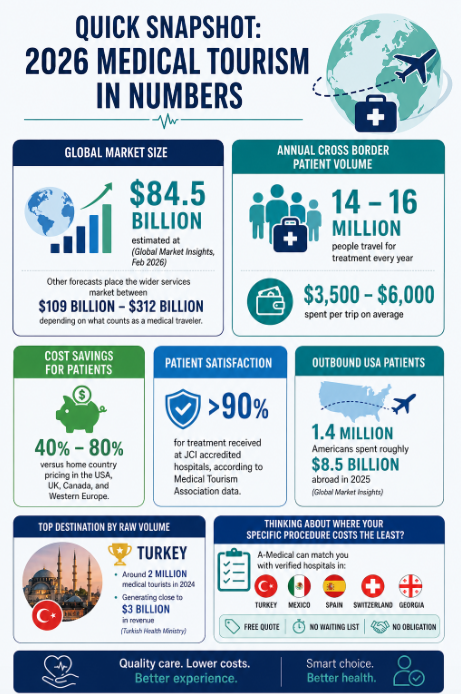
The headline figures, before we get into the country breakdowns:
- Global market size: estimated at $84.5 billion (Global Market Insights, Feb 2026), with other forecasts placing the wider services market between $109 billion and $312 billion depending on what counts as a medical traveler.
- Annual cross border patient volume: roughly 14 to 16 million people travel for treatment every year, spending $3,500 to $6,000 per trip on average.
- Cost savings for patients: 40% to 80% versus home country pricing in the USA, UK, Canada, and Western Europe.
- Patient satisfaction: above 90% for treatment received at JCI accredited hospitals, according to Medical Tourism Association data.
- Outbound USA patients: about 1.4 million Americans spent roughly $8.5 billion abroad in 2025 (Global Market Insights).
- Top destination by raw volume: Turkey, with around 2 million medical tourists in 2024 generating close to $3 billion in revenue (Turkish Health Ministry).
Thinking about where your specific procedure costs the least? A-Medical can match you with verified hospitals in Turkey, Mexico, Spain, Switzerland, and Georgia. Free quote, no waiting list, no obligation.
The Market Is Bigger Than Most People Realise

Different research firms publish different totals because they measure different things. Some include only hospital fees. Others bundle in flights, hotels, translators, and post operative wellness packages, which can add 20% to 30% to a procedure bill (UN Tourism, 2025).
Here is what the major 2026 reports actually say:
- Global Market Insights (Feb 2026): $76.1B in 2025, rising to $84.5B in 2026, projected $174.1B by 2035 at 8.4% CAGR.
- Fortune Business Insights: $46.78B in 2026, growing to $250B by 2034 at 23.3% CAGR.
- Mordor Intelligence (Jan 2026): $110.97B in 2026, reaching $258B by 2031 at 18.4% CAGR.
- Future Market Insights: $312.5B in 2026, expanding to $1 trillion by 2036.
The wide range tells you something honest: nobody has a perfect number. What everyone agrees on is direction. Patient flows are growing every single year, faster than the wider tourism industry, faster than overall healthcare spending.
Why Patients Actually Travel for Treatment
Cost is the loudest motivator, but not the only one. A 2016 CDC surveillance study (Behavioral Risk Factor Surveillance System) asked 506 American medical tourists why they went abroad. Their answers, in order:
- Too expensive in the United States, 51% (and 70% of those were dental cases).
- Not covered by insurance, 14%.
- More familiar or comfortable with the procedure abroad, 7%.
- Believed quality of care was better elsewhere, 6%.
- Treatment not available in the United States, 3%.
McKinsey found something surprising in its earlier research: about 40% of medical tourists travel for advanced technology and specialist expertise, not the cheap price. Another 32% cite better, more human attention than they get at home. The myth that medical tourists are bargain hunters fails to explain why patients fly from Dubai to Boston for proton therapy or from Britain to Switzerland for stem cell programs.
Wait times matter too. NHS England reported a 25 week median wait for total knee replacement in 2024. The same surgery gets booked within 4 weeks in Thailand or India. For someone in chronic pain, that gap is not abstract.
Top Medical Tourism Destinations: 2026 Patient Numbers
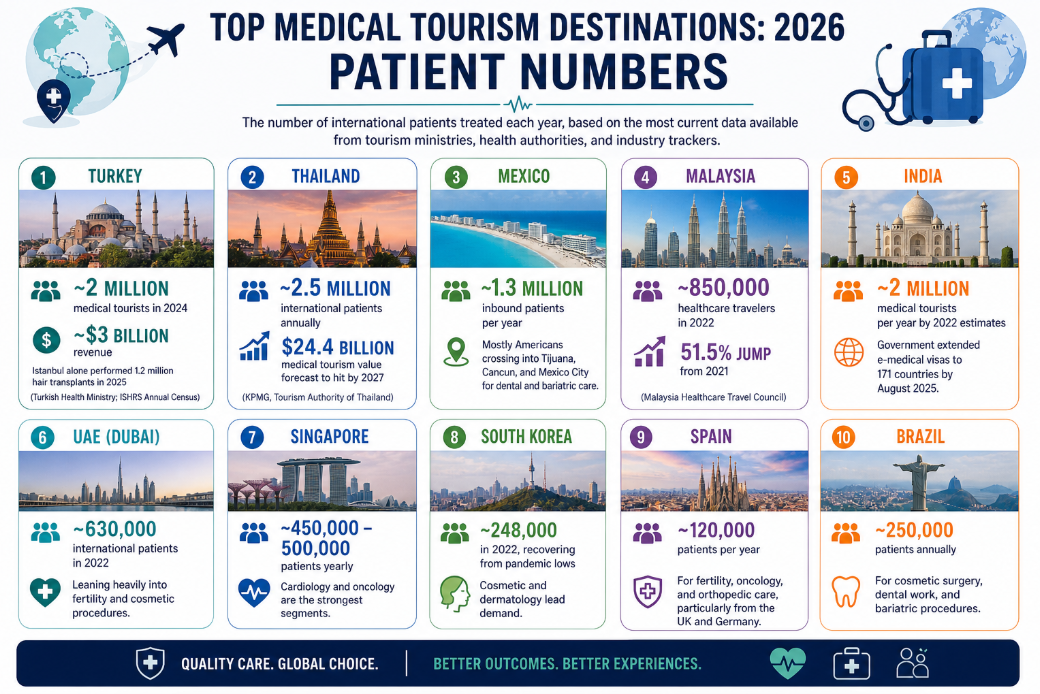
Here is who is treating how many international patients, based on the most current data available from each country's tourism ministry, health authority, and industry trackers. These medical tourism numbers reflect 2024 and 2025 reporting where 2026 figures are not yet finalised:
- Turkey: ~2 million medical tourists in 2024, ~$3 billion revenue (Turkish Health Ministry); Istanbul alone performed 1.2 million hair transplants in 2025 (ISHRS Annual Census).
- Thailand: ~2.5 million international patients annually, with total medical tourism value forecast to hit $24.4 billion by 2027 (KPMG, Tourism Authority of Thailand).
- Mexico: ~1.3 million inbound patients per year, mostly Americans crossing into Tijuana, Cancun, and Mexico City for dental and bariatric care.
- Malaysia: ~850,000 healthcare travelers in 2022, a 51.5% jump from 2021 (Malaysia Healthcare Travel Council).
- India: ~2 million medical tourists per year by 2022 estimates, with the Government extending e-medical visas to 171 countries by August 2025.
- UAE (Dubai): ~630,000 international patients in 2022, leaning heavily into fertility and cosmetic procedures.
- Singapore: ~450,000 to 500,000 patients yearly, with cardiology and oncology as the strongest segments.
- South Korea: ~248,000 in 2022, recovering from pandemic lows; cosmetic and dermatology lead demand.
- Spain: ~120,000 patients per year for fertility, oncology, and orthopedic care, particularly from the UK and Germany.
- Brazil: ~250,000 patients annually for cosmetic surgery, dental work, and bariatric procedures.
Turkey: The Numbers Behind the Boom

Turkey did not become the world's busiest medical tourism hub by accident. Three structural advantages keep its medical tourism statistics 2026 ahead of every other destination:
- Surgeon density: an Istanbul DHI hair transplant specialist performs 300 to 400 procedures yearly. The same specialist in London performs 30 to 40.
- Government regulation: USHAŞ, established by the Turkish Ministry of Health in 2019, certifies clinics and oversees international patient pathways.
- All inclusive packages: most clinics bundle accommodation, transfers, translation, and aftercare into a single fixed price, instead of itemising each step separately like UK or US providers.
Hair transplants alone brought in roughly $1 billion annually for Turkey, according to a 2025 Mayo Clinic and Azerbaijan Medical University review. Beyond hair, top Turkish destinations include Acibadem Healthcare Group, Medicana Health Group, Memorial Healthcare, and Anadolu Medical Center in affiliation with Johns Hopkins Medicine.
For people focused on hair restoration, our breakdown of the 10 best and cheapest countries for a hair transplant covers price ranges, graft pricing models, and clinic vetting checklists: https://amedical.az/en/blogs/destinations/best-and-cheapest-countries-for-a-hair-transplant
India, Thailand, and the Asia Pacific Story
Asia Pacific holds 46.4% of the global medical tourism revenue in 2026 (Persistence Market Research), and it is the fastest growing region. A few country specific figures worth knowing:
- India: ~$9 billion sector by 2022 estimates; Apollo Hospitals, Fortis Healthcare, Max Healthcare, and Medanta lead inbound patient volume.
- Thailand: 60+ JCI accredited hospitals; Bumrungrad International, Bangkok Hospital, and Samitivej Hospital handle the majority of international cases.
- Singapore: Mount Elizabeth, Raffles Medical Group, and Gleneagles dominate the high acuity inbound patient market.
- South Korea: JK Plastic Surgery and Wonjin Beauty Medical Group lead aesthetic tourism, drawing patients from China, Russia, and increasingly the Middle East.
- Malaysia: Prince Court Medical Centre, Sunway Medical Centre, and Gleneagles Kuala Lumpur are the busiest international patient hubs.
Robotic platforms now support around 30% of surgeries in India's private sector (Mordor Intelligence, 2026), and Thailand plans to equip 100 public hospitals with surgical robots by the end of 2026. Cheap is the entry hook. Technology is what keeps patients coming back.
How Much Do You Actually Save? 2026 Procedure Cost Comparison
Numbers below reflect average all inclusive pricing in 2026 (procedure plus standard hospital stay, excluding flights). Sources: Patients Beyond Borders, Statista 2025 Hair Transplant Cost Worldwide, OECD Health Statistics 2024, Mordor Intelligence 2026, A-Medical clinic data.
|
Procedure |
USA |
UK |
Turkey |
India |
Mexico |
|
Heart Bypass (CABG) |
$123,000 |
£35,000+ |
$13,900 |
$7,900 |
$27,000 |
|
Hip Replacement |
$40,000 |
£14,000 |
$13,900 |
$7,200 |
$13,500 |
|
Knee Replacement |
$35,000 |
£12,500 |
$10,400 |
$8,500 |
$12,000 |
|
Dental Implant (single) |
$5,000 |
£2,400 |
$650 |
$900 |
$800 |
|
IVF Cycle |
$15,000 |
£8,000 |
$3,500 |
$3,200 |
$5,600 |
|
Hair Transplant (FUE) |
$13,610 |
£8,500 |
$2,500 |
$2,800 |
$4,000 |
|
Gastric Sleeve |
$22,000 |
£10,500 |
$4,200 |
$5,800 |
$6,000 |
|
Rhinoplasty |
$11,500 |
£6,500 |
$3,200 |
$2,800 |
$4,500 |
A few takeaways from this table:
- Dental and hair restoration deliver the steepest savings, often 80% or more versus US pricing.
- Heart bypass in India costs roughly 6% of the US price. Even adding flights and a 10 day hotel stay, total savings clear $100,000.
- Mexico is the strongest value for North American patients on bariatric and dental procedures, mostly because of geography.
- Turkey wins the cosmetic and hair transplant categories on raw price, but the gap narrows on complex cardiac and oncology cases where India and Thailand lead.
Which Procedures Dominate Medical Tourism in 2026?
Treatment mix has shifted slightly since the pre pandemic era. Cosmetic still leads, but fertility and stem cell categories are growing fastest. Latest segment shares (Persistence Market Research, 2026; Grand View Research, 2026):
- Cosmetic and aesthetic surgery: 24% to 28% of all medical tourism (rhinoplasty, liposuction, breast augmentation, BBL, hair transplant).
- Dental: ~15% (implants, veneers, full mouth restoration, All-on-4 and All-on-6).
- Fertility (IVF, ICSI, egg donation, surrogacy where legal): ~12% and growing fastest.
- Orthopedic (hip, knee, shoulder replacement, spinal fusion): ~10%.
- Ophthalmic (LASIK, cataract surgery, retinal procedures): ~10%.
- Oncology (chemotherapy, radiation, proton therapy, CAR-T cell therapy, immunotherapy): ~8%.
- Cardiac (CABG, valve replacement, angioplasty): ~8%.
- Bariatric (gastric sleeve, gastric bypass, gastric balloon): ~7%.
- Neurology and neurosurgery (DBS, spine, brain tumor removal): ~6%.
- Stem cell and regenerative medicine: smaller percentage but tripled in search volume since 2023.
If fertility is what brings you to this page, our guide to the best and cheapest countries for IVF treatment abroad compares success rates by age group, average cycle costs, and donor egg policies across 8 leading destinations: https://amedical.az/en/blogs/destinations/best-countries-for-ivf
Patient Spending and Economic Footprint
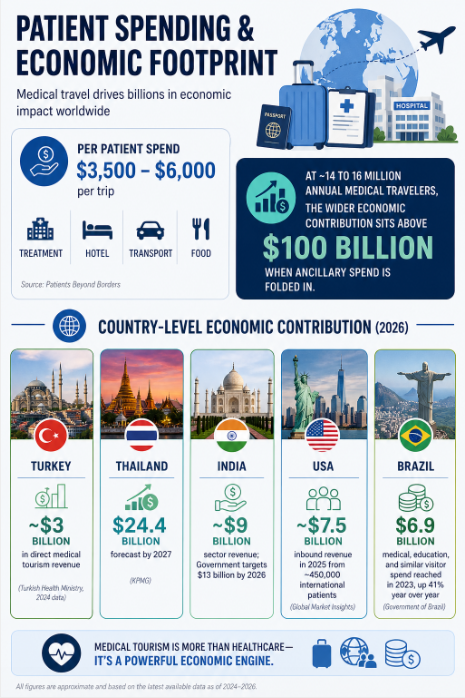
Cross border patients spend an average of $3,500 to $6,000 per trip, including treatment, hotel, transport, and food (Patients Beyond Borders). At ~14 to 16 million annual medical travelers, the wider economic contribution sits above $100 billion when ancillary spend is folded in.
Country level economic contribution looks like this in 2026:
- Turkey: ~$3 billion in direct medical tourism revenue (Turkish Health Ministry, 2024 data).
- Thailand: forecast $24.4 billion by 2027 (KPMG).
- India: ~$9 billion sector revenue; Government targets $13 billion by 2026.
- USA: ~$7.5 billion inbound revenue in 2025 from ~450,000 international patients (Global Market Insights).
- Brazil: medical, education, and similar visitor spend reached $6.9 billion in 2023, up 41% year over year (Government of Brazil).
The Risks Patients Often Underestimate
Statistics tell the rosy half of the story. The honest version includes complications, regulatory inconsistency, and post operative gaps. Anyone reviewing medical tourism statistics 2026 deserves the full picture:
- Black market clinics: in Turkish hair transplant alone, repair cases linked to unlicensed prior procedures rose from 6% in 2021 to 10% in 2024 (ISHRS 2025 Census).
- Post operative complications: home country health systems often shoulder the cost of fixing botched procedures, with no clear chain of accountability.
- Infection outbreaks: a notable 2013 to 2014 case saw multistate US outbreaks of mycobacterial infections traced back to cosmetic surgery in the Dominican Republic (CDC).
- Travel after surgery: blood clots, deep vein thrombosis, and wound dehiscence rise sharply when patients fly within days of major surgery.
- Continuity of care: cardiac, oncology, and complex orthopedic cases need long term follow up that is hard to coordinate from another continent.
- Legal recourse: malpractice protections vary wildly by country. Some destinations cap damages at amounts that would not cover a single follow up visit in the US.
None of these are reasons to avoid medical tourism. They are reasons to pick an accredited facility (JCI, GHA, AACI), insist on documented surgeon credentials, and use a facilitator who actually screens clinics rather than collecting commissions from any provider that pays.
Who Are the Best Candidates for Medical Tourism?
Based on patterns from 2026 patient surveys and clinical experience, the strongest candidates share a few traits:
- Uninsured or underinsured patients facing high out of pocket costs at home (the largest single demographic).
- People needing elective procedures with predictable recovery windows (dental, cosmetic, hair restoration, IVF, joint replacement).
- Patients on long public health system waiting lists (NHS in the UK, provincial systems in Canada).
- Those seeking treatments not approved in their home country (certain stem cell protocols, some fertility options, specific cancer therapies).
- Patients in good general health who can travel safely after surgery.
- People with a clear post operative care plan in their home country and a doctor willing to coordinate follow up.
Less suitable candidates include patients with multiple comorbidities, anyone needing emergency or unstable care, those without family or caregivers to support recovery, and patients whose home country insurance refuses to cover any follow up after foreign treatment.
How A-Medical Fits Into These Statistics
These numbers describe the industry. They do not describe the experience of being a patient inside it. That is where A-Medical works differently from the average facilitator:
- No waiting lists. Most procedures get scheduled within 1 to 3 weeks of confirmation, often within days for time sensitive cases.
- Direct match with vetted clinics and surgeons, not whoever pays the highest commission.
- Affordable pricing at every step, with all inclusive packages that fold accommodation, transfers, translator support, and aftercare into one transparent quote.
- Personal coordinators who handle visa documentation, hospital paperwork, and post discharge follow up communication with your home doctor.
- Coverage across Turkey, Mexico, Switzerland, Spain, Georgia, and Azerbaijan, so destination choice matches the procedure rather than the other way around.
- English, Turkish, Russian, Spanish, and Azerbaijani speaking patient managers throughout the process.
Curious where your specific procedure ranks for affordability? Compare options in our best and cheapest countries for plastic surgery guide: https://amedical.az/en/blogs/destinations/best-and-cheapest-countries-for-plastic-surgery
Trends Reshaping the 2026 Numbers
A few shifts worth tracking in the medical tourism statistics 2026 reports, because they will change the numbers over the next 24 months:
- E medical visas: India alone extended e medical visa access to 171 countries by August 2025; Turkey, Thailand, and the UAE now process medical visas in 24 to 72 hours.
- AI assisted matching: facilitators are using AI to pair patients with the right clinic faster, cutting research time from weeks to hours.
- Bundled wellness recovery: clinics in Switzerland, Thailand, and Costa Rica are pairing surgical procedures with structured rehabilitation and longevity programs.
- Telemedicine continuity: pre operative consults and post operative checkups are increasingly handled by video, reducing the need for second flights.
- Stem cell and regenerative medicine demand: searches for stem cell therapy abroad have tripled since 2023, driven by orthopedic and neurological cases.
- Insurance pilots: a few US insurers and self insured employers now offer reduced deductibles for treatment at pre approved foreign hospitals.
If neurological or autoimmune conditions are your reason for looking abroad, our breakdown of best stem cell therapy clinics and countries covers protocols, costs, and outcome data: https://amedical.az/en/blogs/destinations/best-and-cheapest-countries-for-stem-cell-therapy
FAQ
How big is the medical tourism industry in 2026?
The medical tourism industry in 2026 is valued between $84.5 billion (Global Market Insights) and $312.5 billion (Future Market Insights), depending on whether the figure measures only hospital fees or includes ancillary travel and wellness spending.
Which country gets the most medical tourists in 2026?
Turkey leads in raw patient volume in 2026 with around 2 million medical tourists annually, followed by Thailand at roughly 2.5 million when expat care is included, and Mexico with about 1.3 million inbound patients per year.
How much do patients save by going abroad for treatment?
Patients save 40% to 80% on procedures abroad versus US, UK, or Western European pricing, with the deepest savings on dental work (up to 85%), hair transplants (70% to 80%), and cardiac surgery (90% in destinations like India).
How many Americans travel abroad for medical care each year?
About 1.4 million Americans travel abroad for medical care annually as of 2025, spending roughly $8.5 billion combined, with Mexico, Costa Rica, Thailand, India, and Colombia as their top five destinations (Global Market Insights, 2026).
What are the most common procedures in medical tourism?
The most common medical tourism procedures in 2026 are cosmetic surgery (24% to 28% of patients), dental treatments (15%), fertility and IVF (12%), orthopedic surgery (10%), and ophthalmic procedures including LASIK and cataract surgery (10%).
Is medical tourism safe in 2026?
Medical tourism is safe when patients choose JCI, GHA, or AACI accredited hospitals, verify surgeon credentials individually, and plan post operative follow up before traveling; over 90% of patients at accredited facilities report satisfaction with their care.
How do I choose a country for medical treatment abroad?
Choose a country based on your specific procedure rather than overall price, since each destination specialises differently: Turkey for cosmetic and hair restoration, India for cardiac and orthopedic, Thailand for wellness combined surgery, Mexico for dental and bariatric, Spain and Switzerland for fertility and oncology.
Ready to Look at Your Own Numbers?
The statistics in this article describe averages. Your case is specific. A-Medical can pull a real cost estimate from accredited hospitals in Turkey, Mexico, Switzerland, Spain, and Georgia within 24 hours, with no booking fee and no pressure to commit. Send us your case details and we will reply with a transparent breakdown of options, surgeons, and total package pricing.